



Crypto news, 27 November 2026: Spain lets Sepblac suspend crypto accounts, ESMA to overhaul the MiCA register, unauthorised access to Zodia Custody data and the flaw behind the Chainflip attack
In Spain a decree lets Sepblac suspend crypto-asset accounts for a few days without a judge, ESMA announces a new MiCA register for mid-2027, Zodia Custody reports unauthorised access to contact data and Chainflip identifies the flaw in libzmq.
Friday, 27 November 2026. According to CoinGecko, at around 18:20 Swiss time bitcoin trades at about 59,850 dollars (-1.1% in 24 hours) and ether at about 1,669 dollars (-1.4%). US stock markets were closed on Thursday for Thanksgiving and today's session is shortened, so the latest Farside figure for US spot bitcoin ETF flows is still the one for 25 November.
Spain: Sepblac will be able to suspend crypto-asset accounts
Royal Decree-Law 44/2026, published in the Boletín Oficial del Estado on 25 November, mainly deals with consumer credit, but one of its final provisions adds Article 46 bis to Spain's anti-money laundering law. The financial intelligence unit Sepblac will be able to suspend, on its own initiative and without prior court authorisation, pending transactions for up to ten business days and the use of bank, payment or crypto-asset accounts for up to five business days, where there are signs of money laundering or terrorist financing. Once the deadlines expire, the measure ends unless a judge ratifies or extends it at the request of the public prosecutor. Until now Sepblac could only act at the request of foreign units. The decree transposes Article 24 of Directive (EU) 2024/1640, enters into force on 25 January 2027 and still has to be validated by Parliament. It applies to accounts held with intermediaries, not to self-custody wallets.
EU: ESMA to overhaul the MiCA register around mid-2027
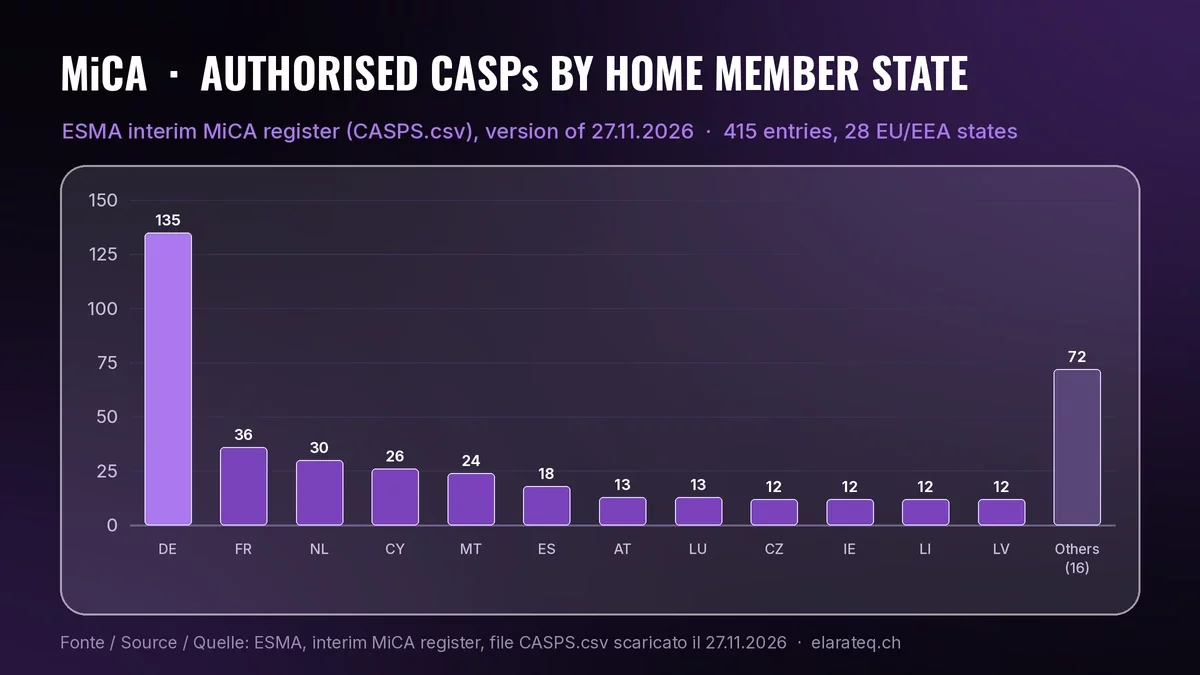
An ESMA spokesperson told Cointelegraph that the interim MiCA register, currently a set of CSV files fed by e-mail from national authorities, will be replaced around mid-2027 by a searchable web platform. The new system will cross-check data against the international LEI database (GLEIF), host white papers directly with a version history and offer CSV downloads and API access. ESMA's MiCA page still refers to integration into its IT systems by mid-2026. The file of authorised crypto-asset service providers (CASPs), updated today, lists 415 entries in 28 European Economic Area states: Germany accounts for 135, France 36 and Liechtenstein 12.
Custody: unauthorised access to Zodia Custody data
Zodia Custody, the institutional crypto custodian controlled by Standard Chartered, said it detected attempts to probe its platform on 23 November and took its B2B API offline as a precaution, restoring it with additional security measures. On 24 November it found that an unauthorised party had accessed limited information: public details on client organisations and, for a small number of clients and employees, a business contact name and e-mail address. According to CEO Richard Clark, there have been no unauthorised transactions so far; clients and regulators have been informed. Data of this kind can be used for targeted phishing.
Chainflip: the flaw behind the 21 November attack identified
In its second report on the 21 November attack, in which 133.34 BTC, 520.22 ETH and about 4 million dollars in stablecoins were taken (about 12.6 million in total), Chainflip names a use-after-free flaw in the libzmq messaging library as the entry point. After registering a validator account, the attacker apparently ran code on validator machines and copied enough key shares to sign vault transactions. The flaw is fixed from libzmq 4.3.3; all active validators now run 4.3.4 and will be replaced with new machines and credentials. No flaws were found in the vault contracts or the threshold signature scheme. The protocol remains paused until the review is complete.
Sources
- CoinGecko, bitcoin price: https://www.coingecko.com/en/coins/bitcoin
- Farside Investors, daily bitcoin ETF flows: https://farside.co.uk/btc/
- BOE, Royal Decree-Law 44/2026 of 24 November 2026: https://www.boe.es/diario_boe/txt.php?id=BOE-A-2026-24702
- CriptoNoticias, Sepblac powers over crypto accounts: https://www.criptonoticias.com/regulacion/espana-congelar-criptomonedas-5-dias-habiles/
- ESMA, MiCA regulation page: https://www.esma.europa.eu/esmas-activities/digital-finance-and-innovation/markets-crypto-assets-regulation-mica
- ESMA, interim MiCA register, authorised CASPs file: https://www.esma.europa.eu/sites/default/files/2024-12/CASPS.csv
- Cointelegraph, ESMA's new MiCA register: https://cointelegraph.com/news/esma-overhaul-eu-mica-crypto-register-2027
- Zodia Custody, statement on the security incident: https://zodia-custody.com/statement-on-recent-security-incident/
- CoinDesk, Zodia Custody data breach: https://www.coindesk.com/tech/2026/11/26/standard-chartered-s-zodia-custody-suffers-data-breach-exposing-client-information
- Chainflip, incident report (part 2): https://chainflip.io/blog/incident-report-vault-exploit-21-november-2026-part-2
- Chainflip, incident report (part 1): https://chainflip.io/blog/incident-report-vault-exploit-21-november-2026-part-1