


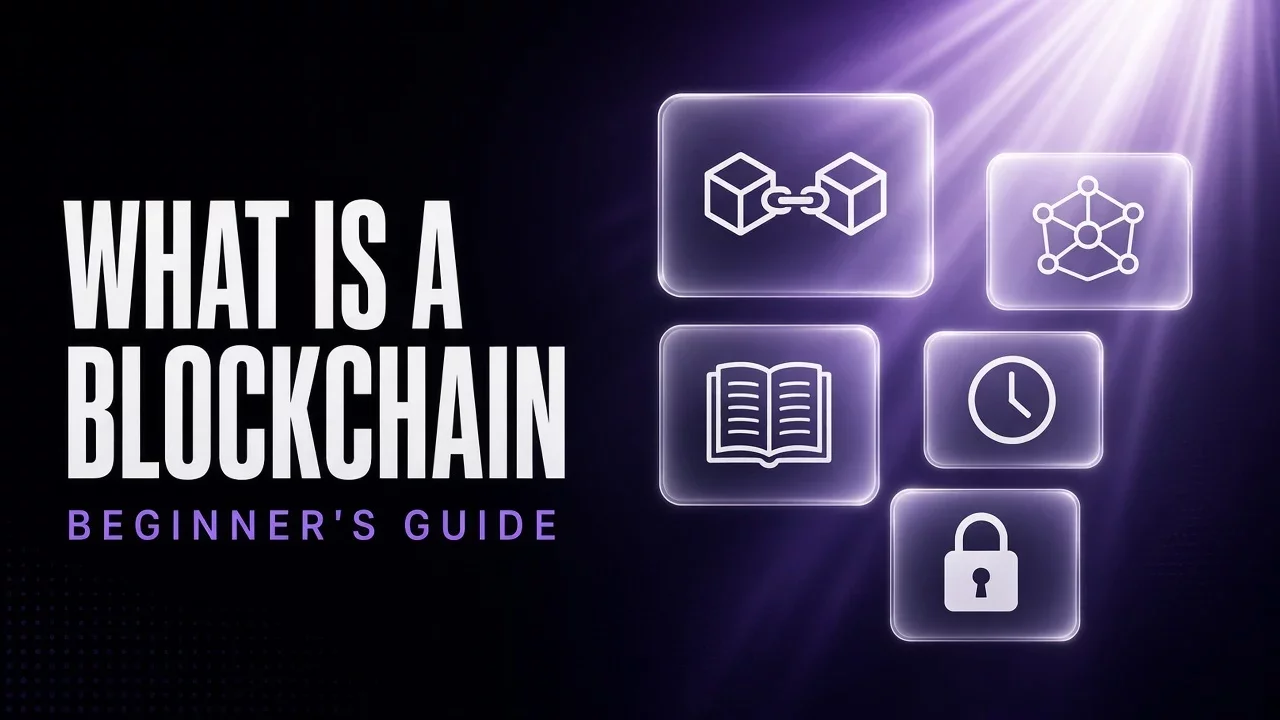
A shared ledger that is hard to tamper with: how it works, the difference between public and permissioned networks and when it makes sense for an SME.
It has been talked about for years, often confusingly. A blockchain, in its most sober definition, is a digital ledger shared among many participants, built so that entries already recorded are very hard to change. This article explains how it works, without jargon, and where its real value lies.
A shared ledger
The US National Institute of Standards and Technology (NIST) describes blockchains as tamper-evident and tamper-resistant digital ledgers, implemented in a distributed fashion and usually without a central authority such as a bank, company or government. A community of users records transactions in a common ledger and, under normal operation, no transaction can be changed once published. The historical starting point is the 2008 paper that introduced Bitcoin: a system of direct payments between parties, without passing through a financial institution acting as guarantor.
Blocks, hashes and the chain
Transactions are collected into blocks. Each block contains a digital fingerprint, called a hash, of the previous block. If someone alters an old entry, the fingerprint changes and the chain no longer adds up. According to NIST, as new blocks are added, older ones become harder to alter: this is the tamper resistance. In the Bitcoin model, transactions are timestamped through a chain of proof of work, and the longest chain is taken as the valid version of history.
Who decides what is valid
The ledger is shared, so a rule is needed to decide which blocks to add. This rule is called consensus. There are several models. In proof of work, used by Bitcoin, participants spend computing power. In proof of stake, adopted by Ethereum in 2022, validators lock up a sum of value as collateral which they can lose if they act dishonestly, according to the Ethereum documentation. Both serve the same purpose: getting participants who do not know each other to agree.
The original Bitcoin paper explains the benefit with an explicit assumption: as long as a majority of computing power is controlled by nodes that are not cooperating to attack the network, they will generate the longest chain and outpace attackers. This means security is not absolute, but depends on how control of the network is distributed. It is a useful concept to remember: a highly concentrated network offers fewer guarantees than a broad, diversified one.
Public and permissioned networks
NIST distinguishes two types of network. In a public, or permissionless, network anyone can read and write to the ledger without authorisation. In a permissioned network, participants are limited and approved. This is an important distinction for businesses. A recent example is the sandbox for a Swiss franc stablecoin, started by Swiss banks and companies: UBS's press release of 8 September 2026 states that the test takes place in a controlled environment, with a restricted pool of participants and transaction limits, and that it is a pilot initiative which does not anticipate any launch decision.
What a blockchain is not
A few clarifications help avoid misunderstandings:
- it is not a magic database: it records what it is told to record, and a wrong entry stays wrong even if it can no longer be changed;
- it is not necessarily public: permissioned networks exist, with controlled access;
- it is not a synonym for bitcoin or cryptocurrencies: these are one application, not the technology itself;
- smart contracts, the programs that run on the blockchain, execute the rules as written, including wrong ones. According to the Ethereum documentation, they generally cannot be deleted and interactions with them are irreversible.
When it can serve an SME
A sober assessment starts from a question: is a ledger shared by several parties that do not fully trust each other really needed? If the data is controlled by a single organisation, a traditional database is generally simpler to manage and correct. This is our own editorial assessment, not a statement from the sources. A blockchain begins to make sense when several parties need to share a reliable record that all can verify, for example in supply chains with many partners, in document certification or in payments between institutions.
In any case, before choosing a technology it is worth defining the problem, the participants, who can correct an error and which regulatory obligations apply. ElaraTeq can help you think through these points before any code is touched.
Sources
- NIST, Blockchain Technology Overview (NISTIR 8202), October 2018: https://nvlpubs.nist.gov/nistpubs/ir/2018/NIST.IR.8202.pdf
- Satoshi Nakamoto, Bitcoin: A Peer-to-Peer Electronic Cash System, 2008: https://bitcoin.org/bitcoin.pdf
- ethereum.org, developer documentation (smart contracts and proof of stake): https://ethereum.org/en/developers/docs/
- UBS, CHF stablecoin sandbox enters test phase and adds SIX and TWINT as new partners, 8 September 2026: https://www.ubs.com/global/en/media/display-page-ndp/en-20260908-stablecoin-sandbox.html
Information, not advice.