



Headless in the Age of AI: Fewer Custom Views, Better Exposed Data
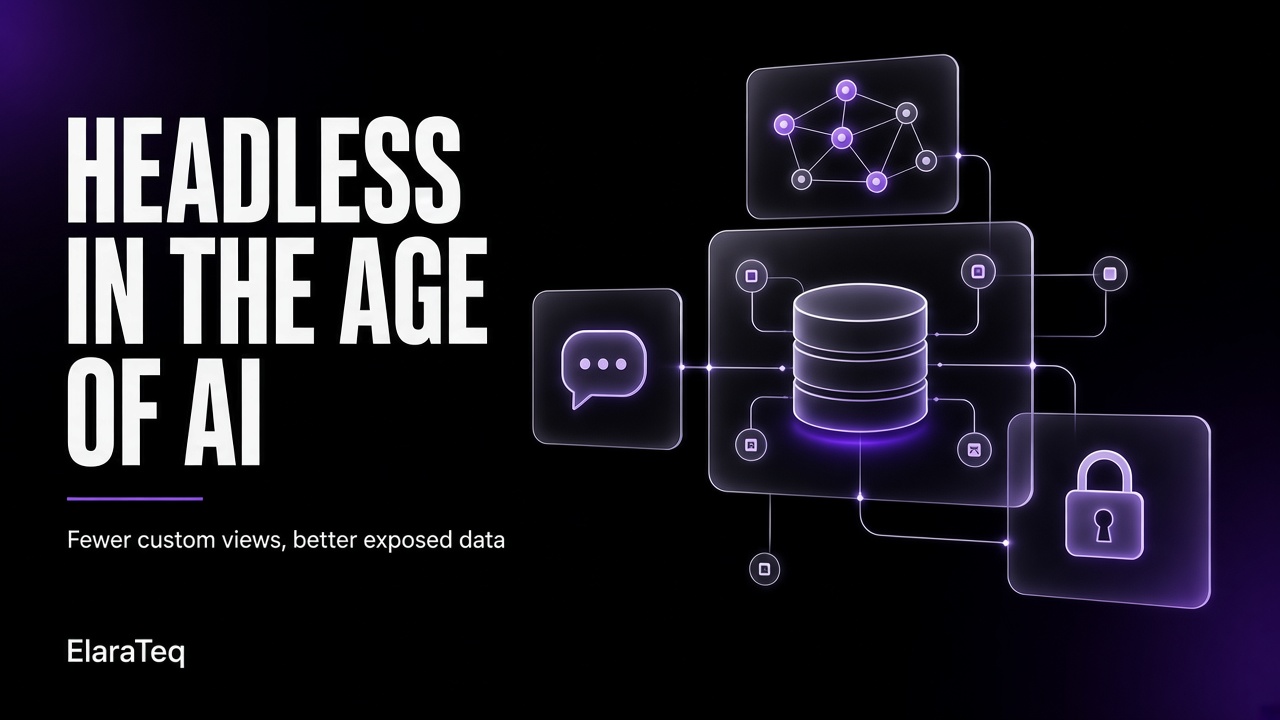
With AI assistants, the way CRM and CMS platforms are designed is changing: the platform exposes structured data through secure APIs and the assistant correlates it on demand. The platform remains the source of truth, and every binding action stays under human confirmation.
The problem with custom views
Over time, every management platform accumulates views and reports. "How many to-dos did each user complete this month?" becomes one screen. "Which cases are still open for each meeting?" becomes another. Every new question requires a development request, testing and maintenance. Real questions, however, change faster than software, and the list of reports is never complete.
The idea: expose data, not answers
In the headless paradigm, the platform does not try to anticipate questions. It exposes raw, well-structured and documented data through APIs. An AI assistant connected to those APIs reads the modules it needs, correlates them and answers a question asked in natural language.
The interface for reasoning is therefore created on the spot, from the question of whoever asks it. There is no view to design in advance: there is a table, a list or a summary generated for that request, which may no longer be needed tomorrow.
What remains with the platform
AI does not replace the management system. The platform remains:
- the archive, where data is stored;
- the register, where every change is tracked;
- the source of truth, which is the reference in case of doubt.
The assistant interprets and summarises, but it is not where the data lives. If an answer from the assistant and the data in the system diverge, the system prevails.
Reads yes, binding actions under confirmation
An assistant can propose a change: updating a status, recording a note, preparing a document. Writes and actions with consequences, such as dispatches, approvals or significant status changes, remain under human confirmation. A person sees what is about to happen and decides. For read-only APIs the risk is low; for write APIs, confirmation is part of the process, not an add-on.
Security and data protection
Opening APIs to an assistant requires precise rules. A reasonable setup includes:
- Least privilege: tokens with permissions limited by module and by operation. A token that reads cases does not read accounting.
- Expiry and revocation: every token has a lifetime and can be revoked at any time.
- Deletion disabled: no token can delete data, not even by mistake.
- Call log: every request is recorded, so it is possible to reconstruct what was read, when and with which token.
- Sensitive data excluded: fields that must not leave the platform are not exposed by the API, and are therefore not reachable by the assistant.
The principle is simple: the assistant can only see what the API shows. Protection is decided upstream, in the design of the API, not in the behaviour of the AI.
Honest limits
The model has costs and boundaries that are worth stating.
- Repeated full reads. To answer certain questions, the assistant must read an entire module. On large modules, repeating the read is slow and consumes resources. Filters, pagination and, where needed, aggregation endpoints are required.
- Only exposed fields. The assistant cannot correlate what the API does not expose. If a piece of data is missing from the schema, the question remains unanswered until the schema is extended.
- Recurring queries. If a question is repeated every week, a fixed view or a scheduled routine is faster, cheaper and more predictable than reasoning redone each time.
- Verification. An answer in natural language may contain interpretation errors. For important decisions, the source data should be checked.
The approach does not eliminate views: it reduces their number to those that are genuinely in continuous use.
What changes for those who develop
The work shifts. Less time on screens and reports for each single request, more time on:
- a clean and consistent data model;
- documented APIs, with clear field names and sensible filters;
- a granular permission system;
- logs and audit tools;
- tests for the cases where the API returns too much or too little.
The quality of the data and the documentation becomes the factor that determines the quality of the assistant's answers.
What changes for those who buy software
Anyone evaluating a platform can ask more concrete questions:
- Does the API cover all modules, or only some?
- Can tokens be limited by module and by operation?
- Are there expiry, revocation and a call log?
- Can deletion via API be disabled?
- Which fields are excluded, and who decides?
- Do writes require human confirmation?
- Does the data remain exportable in an open format?
A closed system, without APIs or with partial ones, limits what an assistant can do. An open system without permission controls exposes users to unnecessary risks. Both are needed: openness and control.
In summary
The headless paradigm is not a new interface trend: it is a different way of dividing the work. The platform stores, records and guarantees. The assistant reads, correlates and answers. The person decides and confirms. It works if the APIs are well designed, permissions are tight and the limits are known from the start.