


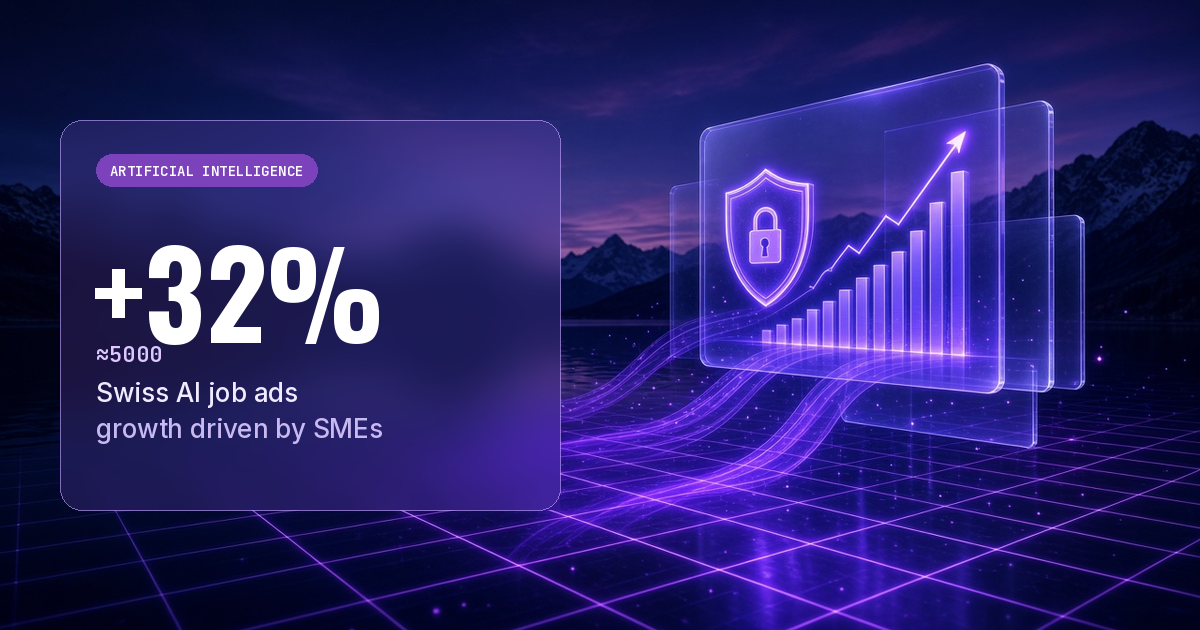
Between July 2025 and June 2026 Switzerland saw almost 5000 AI-related job ads, up 32% year on year. SMEs drove the increase, while 45% of roles sit in the Zurich region. What that means for a Ticino SME.
Between July 2025 and June 2026, almost 5000 AI-related job ads were published in Switzerland, 32% more than the previous year. That is the finding of the Swiss AI Jobs Report 2026 from Lucerne University of Applied Sciences and Arts (HSLU), covered by Keystone-SDA on swissinfo.ch on 8 October 2026.
Growth is no longer limited to large technology firms. SMEs accounted for 76% of the increase in vacancies and published 62% of all AI ads.
Where demand is rising
Demand grew across all ten major economic branches. IT published the most ads (1211). The public sector recorded the strongest growth (+67%).
Almost 40% of ads target Data Engineering and Machine Learning Engineering roles: people who build data infrastructure and keep models reliable over time. Product Owner, Manager and AI Consultant roles are also growing.
Senior positions rose by 42%. Permanent junior hires make up only 5% of the total.
Regionally, the Zurich area recorded 2181 ads, 45% of all Swiss AI positions. According to Curdin Derungs (HSLU), AI is no longer only for large technology companies; it is increasingly built into the processes and services of established SMEs.
What this means for a Ticino SME
Hiring an AI specialist is hard and expensive, and demand is concentrated elsewhere. For many Ticino SMEs it is neither realistic nor necessary to open a Machine Learning Engineer role in order to use AI usefully.
The point is not “having a model in-house”. It is choosing clear use cases, knowing which data you may use, and setting rules on what can go into AI tools.
A parallel picture from the AXA SME labour-market study 2026 (Sotomo, 336 SMEs in German- and French-speaking Switzerland, 11–18 March 2026): 35% already integrate AI into processes, 39% are trying it, 26% are not yet using it. Usage intensity is similar to the previous year, after the jump from 2024 to 2025.
Five practical steps
- Start from a measurable use case. A repetitive process (email drafts, document extraction, internal reports) beats a vague “AI project”.
- Inventory your data. Where it lives (ERP, email, files), who can access it, and what must not leave the company.
- Write a rule on what may enter AI tools. Customer data, contracts and internal information do not belong in services whose terms you do not know.
- Require human confirmation for every action with effects (send, payment, data change, publish).
- Work with partners for website and ERP. Ordered integrations, hosting in Switzerland and protected access reduce risk more than an isolated experiment.
Our approach
ElaraTeq Sagl builds websites, business software and digital services for SMEs and public bodies in Ticino. If you want to see where AI can help your processes without hiring a technical profile the market does not price for SMEs, contact us: we start from use cases and a data inventory, without slogans.
Sources: HSLU Swiss AI Jobs Report 2026 / Keystone-SDA on swissinfo.ch (08.10.2026); AXA SME labour-market study 2026 (15.09.2026).