



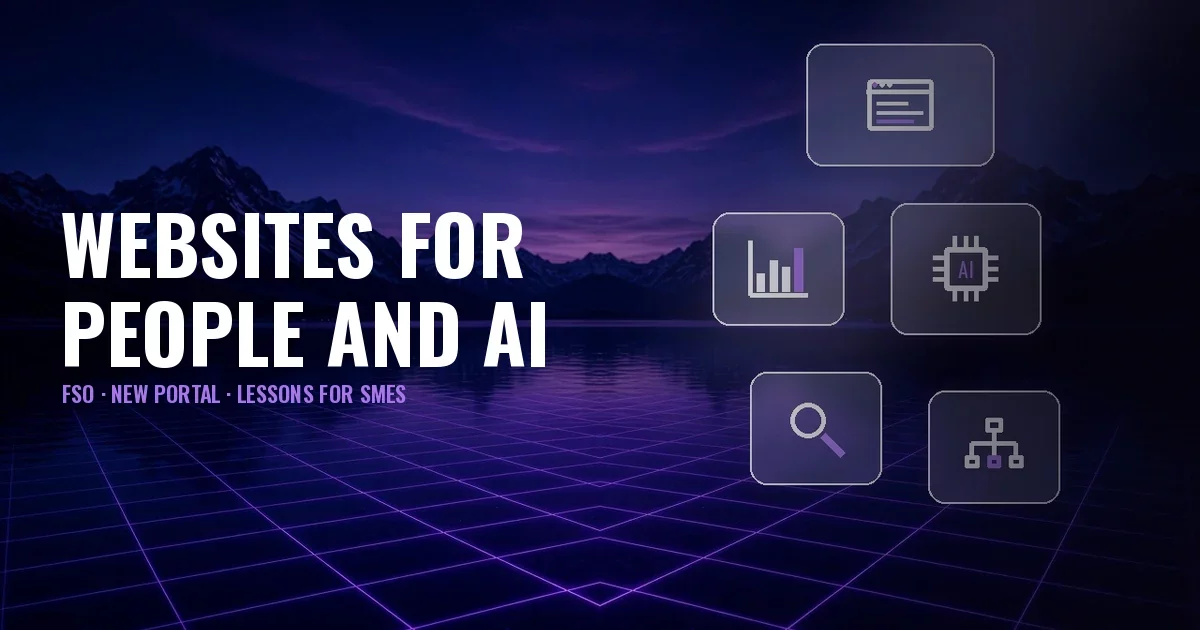
On 29 October 2026 the Federal Statistical Office launched a portal designed for people and AI. Google confirms that its AI features rely on normal SEO best practices, with no special files. What a Ticino SME can check on its own website.
On 29 October 2026 the Swiss Federal Statistical Office (FSO) launched its new web presence under a title that goes beyond statistics: «Reliable information for people and AI». The specialist portal «Swiss Statistics» (statistik.admin.ch) is explicitly designed both for people who consult the data directly and for those who do so through artificial intelligence tools.
This is not only news for people who work with statistics. Customers and suppliers increasingly look for information by asking an AI assistant or by reading a summary generated by a search engine. For a Ticino SME the question is practical: is the information on our website found, understood and reported correctly, by a person as well as by an AI system?
What the FSO did
According to the announcement of 29 October, the FSO split its online presence into two platforms with different goals:
- bfs.admin.ch, the institutional website: who the office is, its tasks and its services;
- statistik.admin.ch, the specialist portal: statistical results, indicators, publications, datasets and visualisations, for users in politics, administration, research, business and the public, «whether directly or with the help of AI».
The web addresses stay the same. The project, called «Neue User Experience» (NUX), was delivered within one year. The FSO’s director explains the choice: AI increasingly delivers answers without it being clear which facts they are based on, which makes it all the more important to make official data visible, verifiable and accessible to everyone.
Why this matters to an SME too
The same principle applies to a company: if reliable information on prices, services, opening hours or terms is hard to find on its own website, a customer’s AI assistant will look for it elsewhere, or reconstruct it inaccurately.
On appearing in AI search features, Google is explicit in its documentation for site owners: the same SEO best practices apply to AI Overviews and AI Mode as to classic search. A page must be indexed and eligible to be shown with a snippet; there are no additional technical requirements, and no special AI text files or dedicated schema.org structured data to add.
What the new portal shows
A check of the public pages of statistik.admin.ch on 10 November shows solid fundamentals rather than tricks: an XML sitemap in which every page is linked to its German, French, Italian and English versions (hreflang), a canonical address for every page and explicit instructions for search engines. There is no llms.txt file, sometimes promoted as «SEO for AI». The strength lies in the structure: content separated by audience and well linked.
What an SME can do with its website
- Separate who you are from what you offer. Like the FSO with its two platforms, even a small site becomes clearer when the company profile, services and practical information have distinct, well-named pages.
- Put important information in text form. Prices, services, areas served, opening hours and terms locked in an image or a scanned PDF are hard to read for a search engine and for an AI system.
- Check that crawlers can access the site. Review the
robots.txtfile and the CDN or hosting settings: an unintended block removes the site from search and therefore from AI-generated answers too. - Link pages to each other. Clear internal links help people and search engines find the relevant content.
- Keep structured data in line with the visible text. If the site uses structured data (address, opening hours, products), it must say exactly what the page says.
- Handle languages properly. For a company working in Italian, German and French, each version must be a real page, linked to the others, not a partial translation.
- Keep the business profile up to date. Google also lists Business Profile information among the data to keep current.
- Measure. Traffic from Google’s AI features is included in Search Console data: verifying the site there is the simplest way to follow the trend.
What is not needed
There is no need to rebuild the website for AI or to buy «AI optimisation» packages based on special files or markup: according to Google they are not required for its AI features. What is needed is a well-organised site with current content, clear sources and dates: the same work that makes the site useful to customers. We have also written about well-structured content and AI in our article on headless systems.
Frequently asked questions
Can we prevent our content from appearing in Google’s AI answers?
Google points to the robots.txt file and the nosnippet, max-snippet and noindex controls; to limit use in other Google systems there is Google-Extended. Blocking everything, however, also means disappearing from search: decide carefully.
Does a small website make sense from this perspective?
Yes. A few clear pages with current information written as text are worth more than many generic pages. Structure matters more than size.
Where should we start?
With the questions customers ask most often by phone or e-mail: if the answer is not on the website, that is the first content to write.
Our approach
ElaraTeq Sagl develops and runs websites for SMEs in Ticino with attention to structure, languages and readability for people and search engines (development, consulting). On AI adoption in Swiss SMEs see also the swiss export 2026 study. To have your website reviewed you can contact us.
Sources
- Federal Statistical Office, Reliable information for people and AI: Federal Statistical Office launches new online presence, press release, 29 October 2026
- Swiss Statistics portal, news item of 29 October 2026
- Google Search Central, AI features and your website
- Swiss Statistics portal, XML sitemap (accessed 10 November 2026)